RTU Researcher Andris Šutka Presents LACISE Project Results at the E-MRS 2025 Spring Meeting
From May 26 to 30, the Spring Meeting of the European Materials Research Society (E-MRS) took place in Strasbourg, France. As one of Europe's leading materials science conferences, the event brings together researchers, industry representatives, and innovation stakeholders to discuss the latest advances in materials synthesis, characterization, and applications in energy, electronics, sustainability, and other fields. The conference featured 23 thematic symposia, plenary sessions, oral presentations, and poster sessions, providing an international platform for scientific exchange and collaboration.
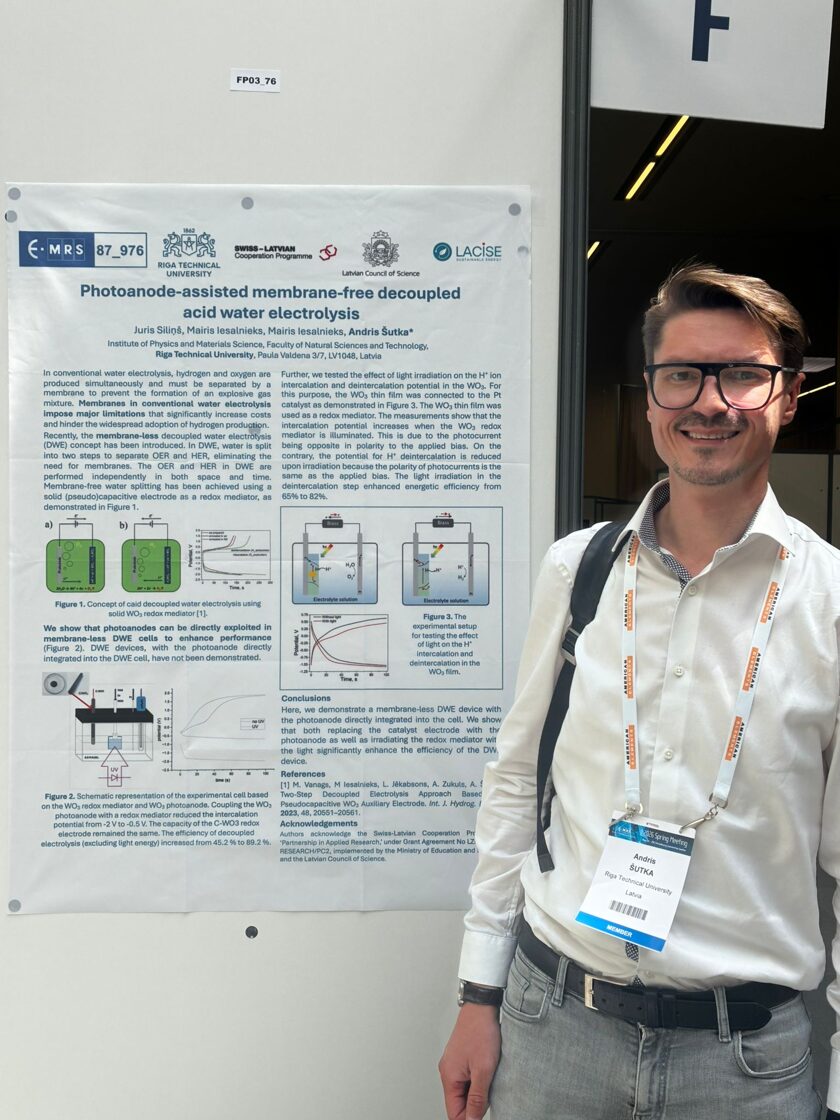
The LACISE project was represented by Andris Šutka, leader of Work Package 5 (WP5) at Riga Technical University (RTU), who presented a poster entitled “Photoanode-assisted membrane-free decoupled acid water electrolysis” within the symposium Engineered Nanomaterials for Energy and Environment: From Synthesis to Applications.
The presented research focused on the development of innovative hydrogen production technologies based on decoupled water electrolysis (DWE). Unlike conventional water electrolysis systems, where hydrogen and oxygen are generated simultaneously and must be separated by a membrane to avoid the formation of explosive gas mixtures, DWE divides water splitting into two independent steps. This approach eliminates the need for membranes, potentially reducing system complexity and operational costs while improving safety.
In the study, RTU researchers demonstrated how a WO₃-based photoanode can be integrated directly into an acidic DWE system to enhance its performance. The technology combines a WO₃ redox mediator, a WO₃ photoanode, and a platinum electrode. During the oxygen evolution step, light irradiation activates the photoanode, facilitating proton intercalation into the WO₃ mediator. In the subsequent hydrogen evolution step, the photoanode is disconnected, and the stored charge is utilized to produce hydrogen. The results showed that incorporating the photoanode significantly reduced the energy required for the process, increasing the overall energy efficiency from 65% to 82%. These findings highlight the potential of photoelectrochemical approaches to develop sustainable, cost-effective green hydrogen production technologies.
Participation in the E-MRS Spring Meeting provided an excellent opportunity to present the latest LACISE project achievements to the international materials science community, exchange knowledge with leading researchers, and explore future collaboration opportunities in the fields of hydrogen technologies, electrochemistry, and advanced functional materials.