International Battery Day: A Look into Battery History and Their Role in Future Innovations
On 18 February, the world celebrates International Battery Day, honouring the Italian physicist Alessandro Volta (born on 18 February 1745), who in 1801 invented the first true battery. His invention marked the beginning of the era of electrochemistry and the practical use of electrical energy — a field that continues to evolve today and remains a key research direction within the LACISE project.
A Glimpse into Battery History
The battery created by Volta — the Voltaic pile — was surprisingly simple: alternating discs of silver (or copper) and zinc, separated by pieces of leather or cardboard soaked in saltwater. Despite its simple design, it became the first device capable of providing a continuous electrical current, laying the foundation for electrical engineering, the discovery of electrolysis, and, later, the age of the telegraph and other electrical devices.
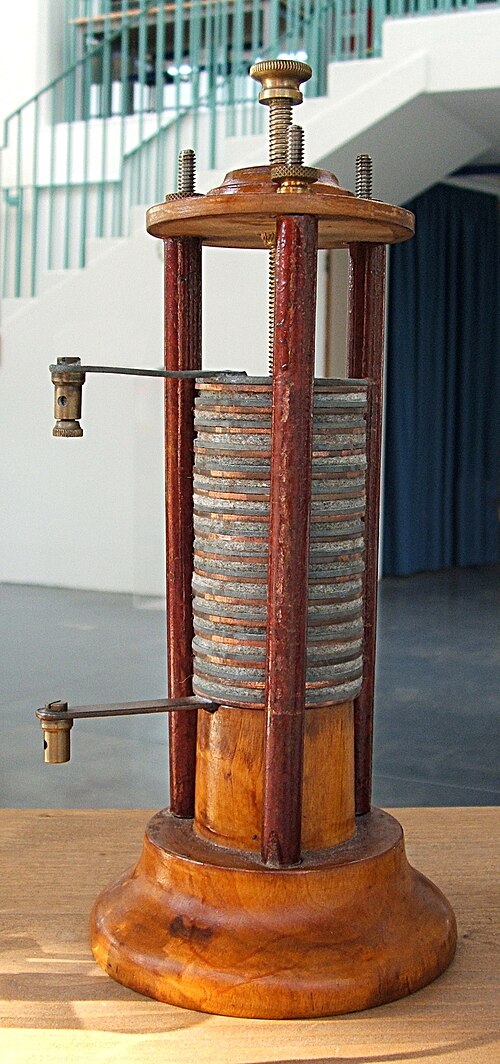 Photo of Voltaic pile by Luigi Chiesa - Own work, CC BY 3.0, https://commons.wikimedia.org/w/index.php?curid=5042106
Interestingly, the principle of the battery may have existed 2,000 years before Volta. In 1938, a clay vessel from the Parthian Empire was discovered near Baghdad. The jar contained a copper cylinder, an iron rod, and an acidic vinegar solution — a construction capable of producing 1.1–2 volts of electricity. While scientists still debate whether this object was truly used as a battery, it highlights how long humanity has been intrigued by electrochemical processes.
The term “battery” was introduced by Benjamin Franklin in 1748, well before Volta’s invention. While experimenting with the charging of Leyden jars, he used the term “electrical battery” to describe several devices connected in series, possibly inspired by the military term referring to a group of artillery units.
From Experiments to the European Green Deal
Today, batteries are integral to modern life — from mobile phones and portable electronics to electric vehicles and renewable energy storage solutions. They play a crucial role in the European Union’s path toward climate neutrality, enabling the transition to electric vehicles, supporting efficient storage of wind and solar energy, and significantly reducing CO₂ emissions in the transport and industrial sectors. The battery field is dynamic and constantly evolving — new materials are being developed, safety is improving, energy density is increasing, and more sustainable production solutions are being sought.
LACISE’s Contribution to the Future of Batteries
Within the LACISE project, battery technology research is one of the three core scientific areas. Our team is working on next‑generation battery materials and solutions that will help increase energy density, enhance safety, extend battery lifespan, and reduce the use of environmentally harmful resources.
These research outcomes are essential for Europe to maintain competitiveness and ensure a sustainable, safe, and efficient battery ecosystem.
Join Us at the First Battery Industry Day – 25 February
LACISE, in collaboration with the Institute of Solid State Physics, University of Latvia (ISSP UL), invites you to the first Battery Industry Day on 25 February.
The event will bring together scientists, industry representatives, and policymakers to share the latest technological discoveries, build bridges of cooperation between research and industry, and discuss strategic priorities for the European battery market.
This day will be an excellent opportunity to explore ongoing battery research at the ISSP UL and jointly discuss future challenges and opportunities.