Hydrogen, curiosity, and the future of mobility: Meet Germans Vlasenko, a school student developing his SRP at the LACISE project
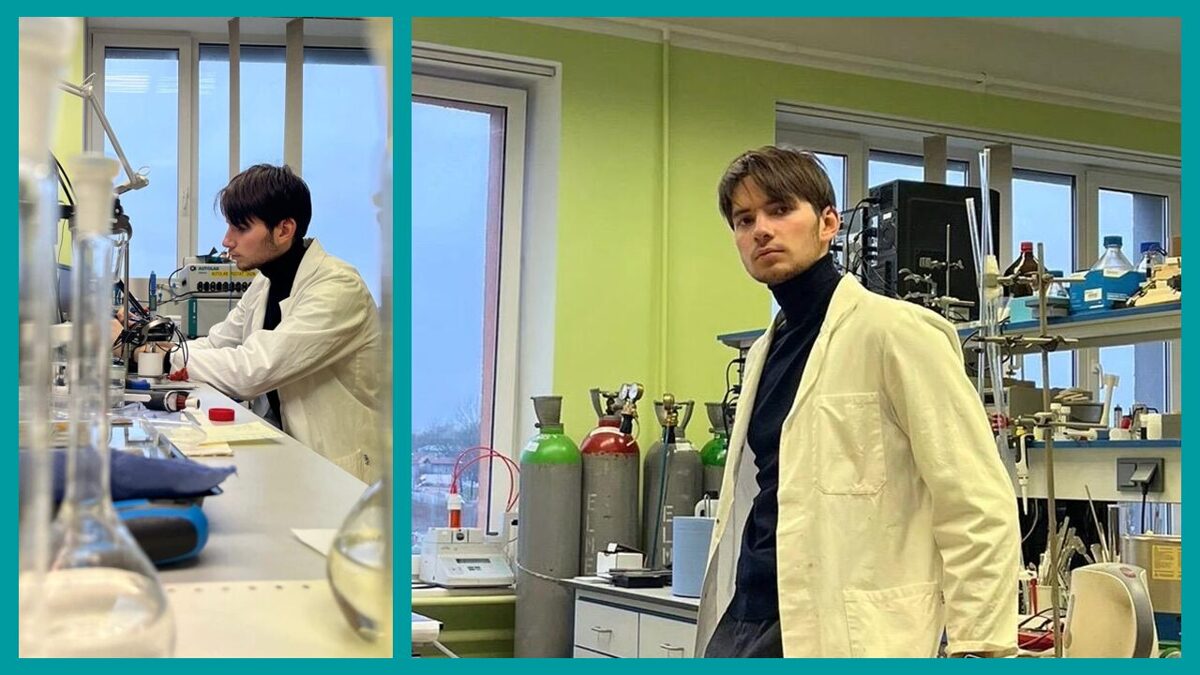 German Vlasenko at the RTU's Institute of Physics and Materials Science
The LACISE project continues to offer young people practical opportunities to engage with real scientific research. This time, we speak with another student carrying out his scientific research paper (SRP) within the project, at the Institute of Physics and Materials Science of Riga Technical University (RTU).
Germans Vlasenko, a 12th-grade student at Riga State Gymnasium No. 2, is one of those young people eager to dive into science not only theoretically but also hands-on. His SRP focuses on decoupled electrolysis using binder-free supercapacitor-type electrodes in an acidic environment – a topic closely linked to the development of modern energy systems and sustainable transport.
Germans’ interest in the topic developed naturally - from his passion for cars and his curiosity about what sustainable transport might look like in the future. “In my SRP, I wanted to explore something related to cars, and hydrogen seemed particularly exciting to me,” he explains. Hydrogen as a potential future fuel—and the possibility of preserving internal combustion engines while reducing their environmental impact—became the foundation of his research.
When Germans contacted Prof. Andris Šutka to explore the possibility of conducting hydrogen-focused research at RTU, his research quickly took shape. “After meeting with Mg. sc. ing. Mairis Iesalnieks, we agreed to work on the topic of decoupled electrolysis,” he recalls.
The path to science begins with a simple question: how does it work?
Germans describes himself as someone deeply interested in physics and chemistry. He studies both subjects in depth and believes they complement each other perfectly. “I like physics and chemistry because they help me understand the world – both in school and beyond,” he says.
STEM fields have always appealed to him, and his teachers have played a significant role in this interest—especially his physics teacher at Riga State Gymnasium No. 2, Mg. Phys. Voldemārs Muižnieks, who has encouraged students for years to participate in competitions and develop research skills.
SRP goal: binder-free electrodes for hydrogen electrolysis
Germans’ SRP is ambitious and fully aligned with today’s energy challenges. His research aims to find and develop a safer, more efficient hydrogen production method than those described in existing literature. After conducting a literature review, he performed hands-on laboratory experiments. His prototype electrode—based on specific capacitance at a scan rate of 10 mV/s—showed approximately 43% higher efficiency than the reference sample described in the literature.
Main objectives of the research:
- Develop binder-free supercapacitor-type electrodes for decoupled electrolysis
- Compare different processing methods to determine which yields the best results
- Evaluate whether heat treatment improves the material surface and electrode properties
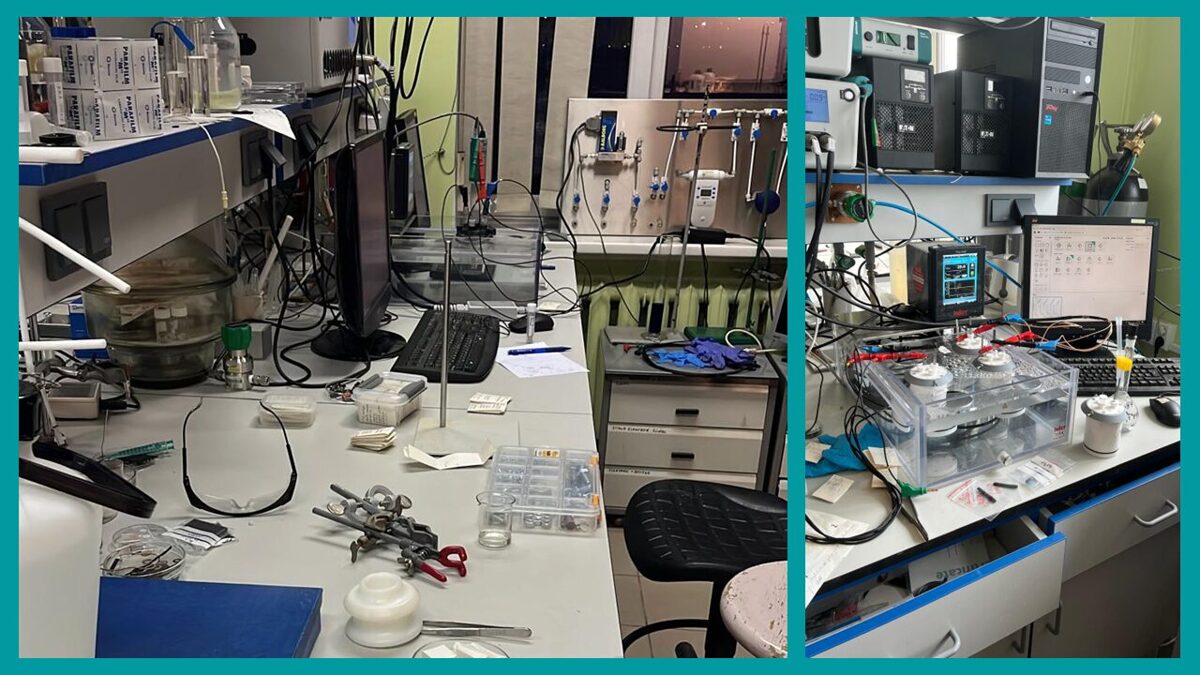 The pictures show the laboratory table on which the sample exchange took place; the container in which the electrochemical cells were immersed during the measurements to maintain a constant temperature, as well as the computer for reading the measurement results. Photo: Germans Vlasenko
First steps in the laboratory
Germans is enthusiastic about his experience at RTU’s Institute of Physics and Materials Science laboratory. At first, the environment felt almost cinematic: “I imagined it would be like in Spider-Man, where Peter Parker synthesizes substances in a high-tech lab. Honestly, reality turned out to be quite similar.” But the daily life of a researcher is more than exciting experiments. It also involves:
- waiting for samples to burn,
- long measurement procedures,
- data analysis that often contradicts initial expectations,
- refining methods, rerunning experiments, and detecting errors.
This experience taught him not only technical skills, but also patience – one of a scientist’s most essential qualities.
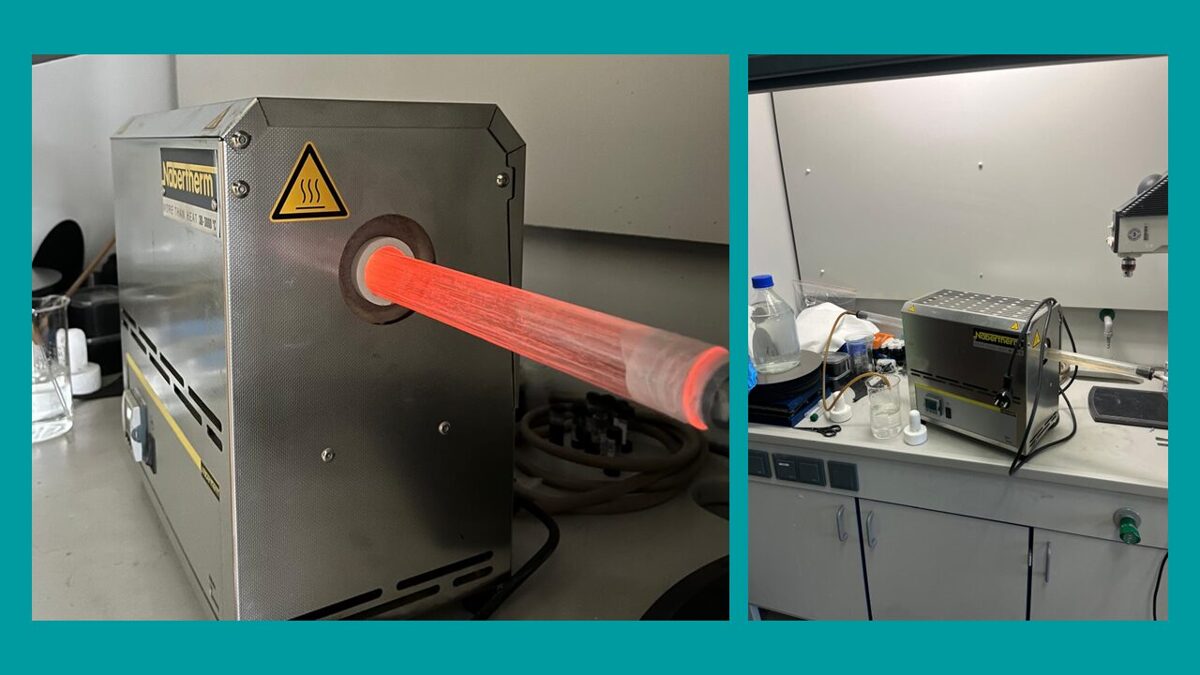 The picture shows the furnace used to treat the samples. Photo: Germans Vlsenko
Surprises and small scientific miracles
Almost everything surprised Germans during his research, but one moment stands out vividly: his first encounter with the scanning electron microscope (SEM).
“It’s a big device that lets you see what’s impossible with the naked eye. It scans the surface with an electron beam – the tiny ‘ball’ we see drawn in physics books. It’s expensive but incredibly valuable when you need to examine surface structure at the micro level.”
A particularly memorable moment came when one of his first binder-free electrodes delivered excellent results – the day before his birthday. But science can be unpredictable: the next identical sample performed significantly worse. That was when he truly understood the research process – investigating causes, analyzing data, and optimizing methods.
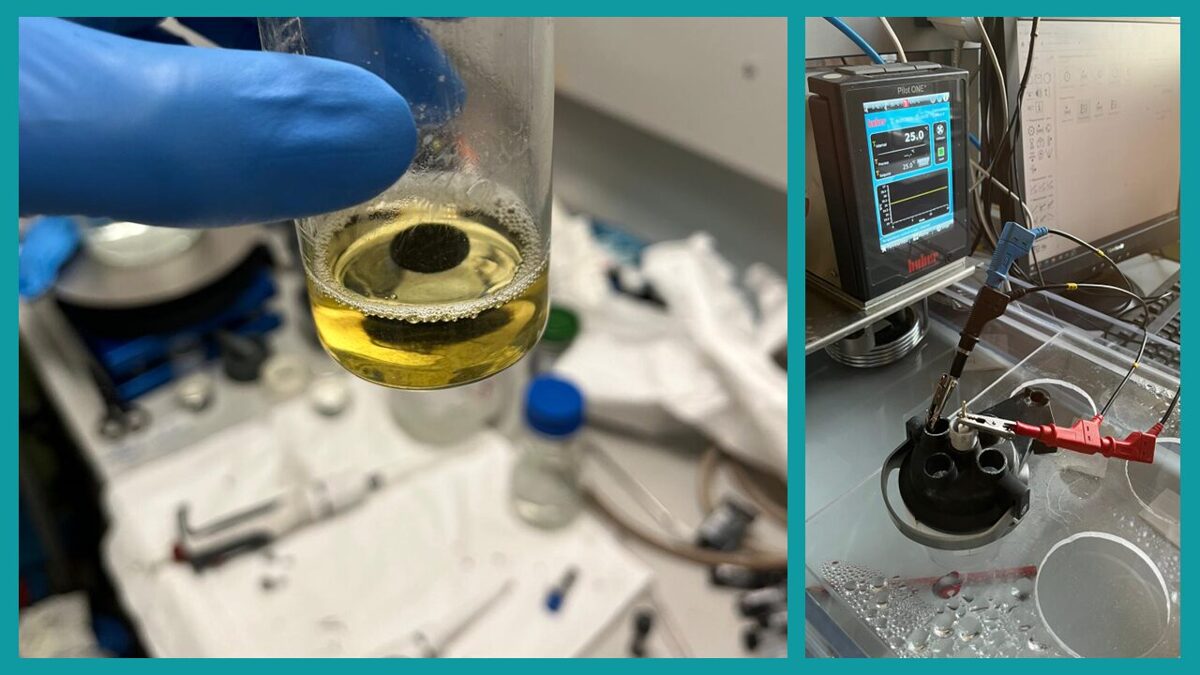 German's sample in solution before drying, and the sample being measured in a two-electrode system to later determine its specific capacitance. Photo: Germans Vlasenko
Support from scientists and the research community
Germans says the support from RTU researchers was indispensable. He is especially grateful to Dr. phys. Mārtiņš Vanags and Mg. sc. ing. Mairis Iesalnieks for their patience, clear explanations, and guidance.
“The hardest part was understanding what exactly I was doing. It might sound funny, but without experience, I didn’t know what results to expect—what was good, what was bad, or what the measurements should even look like,” he says.
He also benefited from getting to know RTU students and learning about their research and study experiences, which broadened his understanding of what a scientist’s work truly entails.
Future plans
Germans has a clear vision: “My dream is to work in motorsports or the automotive industry as an engineer. I’m fascinated by improving things that many people already see as perfect.”
Later in life, he also wants to teach physics. “I love the subject so much that I want to share my passion,” he says. He has already taught a few classes at his gymnasium, which only strengthened this ambition.
What does working on an SRP teach you?
Among the skills he developed, Germans highlights:
- time management,
- reading and understanding scientific literature,
- data analysis and research thinking,
- concentration.
He laughs, quoting his mother: “When you wash the dishes—think about the dishes.” The same applies in the laboratory: focus is everything.
Advice for other students
For students considering collaborating with scientists on their SRP, Germans suggests:
- choose a topic aligned with your future interests,
- don’t be afraid of laboratory work—it’s a great entry point to your future profession,
- start early; if your first measurements fail, you’ll have time to improve your approach.
“An SRP is like Job Shadow Day, except this time you are doing the work,” he says. He believes that a thoughtful approach allows students to gain maximum experience from the process.
A young researcher helping shape the future of energy
Germans Vlasenko’s example shows how young people can get involved in the LACISE project and engage with complex technologies while contributing to future energy solutions. Working with real materials and experimental methods has given him the opportunity to take his first steps into hydrogen research and to gain skills that will undoubtedly be valuable both in his studies and in his future engineering career.