Beyond the Lab Coat - Artūrs Ņikuļins (Institute of Electronics and Computer Science)
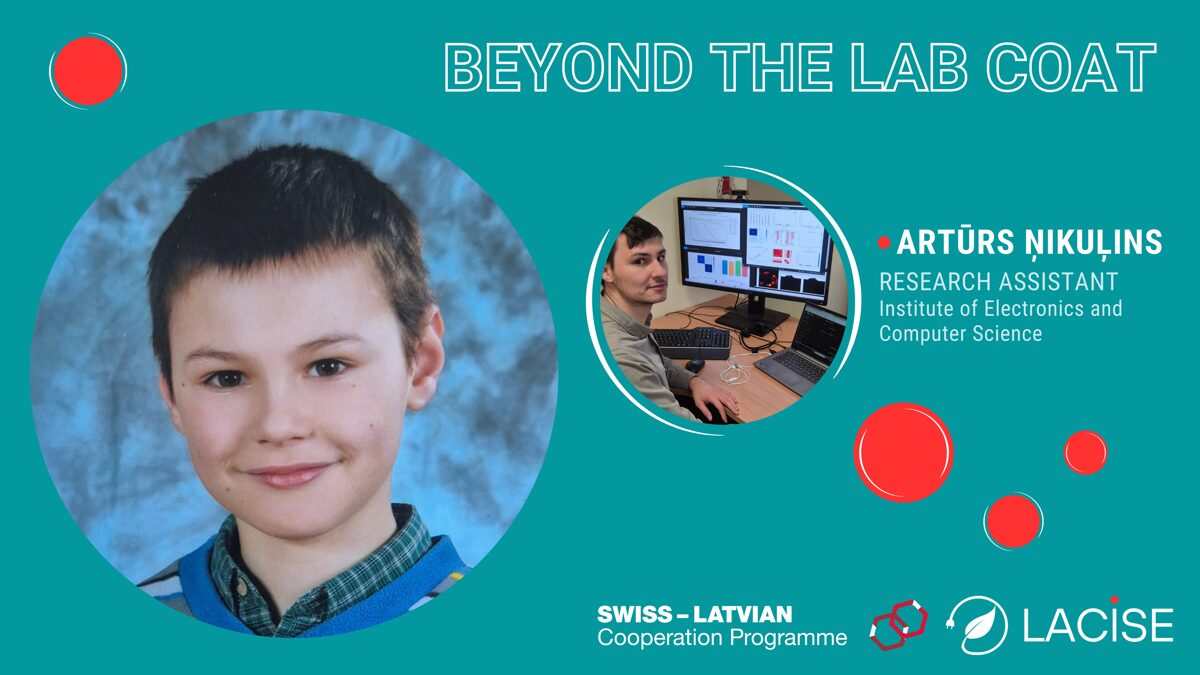 Pictures: Artūrs in his childhood and at work
Did you dream of becoming a scientist as a child?
I position
myself as an artificial intelligence (AI) scientist today, but I did not dream
of becoming a scientist as a child. In fact, I never imagined I would work in
the AI field. It simply wasn’t a visible or accessible topic during my school
years. I was quite good at mathematics and enjoyed physics, but computer
science was not my main interest at that time. I liked informatics only
slightly. We studied basic concepts such as Microsoft Office and simple
algorithms.
I did not grow up dreaming of becoming a scientist; rather, I followed what captured my attention and allowed myself to grow naturally into this path. I tend to go with the flow.
What
inspired you to pursue science?
I always
knew I would choose something technical, and ideally something with a bit of
creativity. I enjoyed listening to music while studying, and that blend of
technical focus and creative atmosphere helped shape my preferences. What
eventually drew me into AI was the realization of how powerful and diverse it
has become - from complex analytical tasks to generating artistic images,
composing music, and offering meaningful advice for everyday life. This field
is still far from perfect, and that motivates me. I appreciate understanding
how these systems work and exploring new research directions.
What
do you love most about being a scientist today?
What I love
most about being a scientist is the constant need to learn something new. While
many fundamental principles remain unchanged, researchers around the world
continue to build innovative methods on top of these foundations. Sometimes
this process leads to genuinely creative breakthroughs, which makes the field
inspiring and dynamic.
I appreciate the pace at which state-of-the-art ideas evolve and the challenge of moving beyond them. Staying updated through research publications and participating in scientific conferences allows me to exchange ideas with scientists from all over the world. This continuous intellectual movement and curiosity-driven progress are what I enjoy the most.
What’s one myth about scientists you’d love to bust?
One myth I
would love to bust is the stereotype that all scientists walk around in lab
coats and glasses. As a child, that was exactly how I imagined a scientist, but
the reality, at least in my field, is quite different. While some laboratories
still require that kind of equipment, modern scientific work is much more
diverse.
Most of the time, science is more like designing a clear roadmap: analysing a problem, planning a solution, and shaping ideas together with colleagues. The safety glasses usually appear only at the final testing stage - just in case something decides to explode. And if it does, we simply return to planning and refining our ideas as a team.
What’s the weirdest or most unexpected thing you’ve learned in your field?
The most
unexpected thing I’ve learned is how many parallels we can draw between
artificial intelligence and the human mind. I was genuinely surprised when I
discovered that AI can compose music or create artwork. These are abilities we
once thought were uniquely human. When we design technology, we often borrow
concepts from nature, taking the best ideas we understand and embedding them
into our creations.
That is where the parallels become clear: AI systems use attention mechanisms to focus on important details before producing a final decision, and they learn their parameters through experience. In many ways, working with AI is similar to teaching a child - guiding, shaping, and supervising its learning process. It can feel a bit unsettling, but it’s still controllable.
What’s your favorite non-science hobby?
I would say
chess. I enjoy board games in general, but chess is one of my favourites. The
number of possible positions exceeds the number of atoms in the universe, which
means the game can never be fully solved, not by humans and not by AI. It
surprises me that modern engines are far stronger than any human player in
chess. AI can generalize extremely well and even demonstrate forms of
creativity when evaluating positions that have never appeared in any database.
If
science were a movie genre, what would it be?
Definitely
futuristic science fiction, because science always feels a step ahead of the
world around us. Many ideas are still experimental, and some are better kept
inside the lab until they mature. And what happens in a scientist’s mind is a
story of its own. A mix of creativity, imagining new possibilities, and finding
fresh solutions to problems that have existed for decades, often using new
tools like AI, which can offer novel approaches and broaden the range of
possibilities.
What’s your favourite movie?
I have
several favourite movies, both scientific and non-scientific. I usually look
for a sense of purpose and adventure, something that resonates emotionally.
“Back to the Future” is a great trilogy that I really enjoy, and “The Green
Mile” is another film that stayed with me. I also appreciate good comedies, and
one of my favourites is the Bollywood film “3 Idiots”, a movie I genuinely
recommend.
What’s your favorite book?
As a
Latvian, I naturally gravitate toward Latvian literature. These stories are
heartfelt, richly written, and I simply enjoy spending time with them. Reading
them helps me rest. Works like “Mērnieku laiki” by the Kaudzīte brothers or
“Lazdu laipa” by Ilze Indrāne are great examples. I also enjoy the work of the
Russian writer Dostoevsky; his books contain deep reflections on human nature.
His characters are multifaceted, revealing new psychological depths as the
story unfolds.
When it comes to scientific reading, I have trained myself to follow research papers and recent achievements online. Books have a unique atmosphere and emotional depth, so I usually read fiction in book form, while for scientific or technical learning I prefer reading on a computer screen.
What
music or song always inspires you?
When I’m
working, I especially enjoy slower music, such as blues or classical. I try to
maintain a sense of inner calm, which I believe is essential in science. It
helps to take the messy, chaotic information from the outside world and
transform it into something meaningful and structured.
If
you weren’t a scientist, what would you be doing today?
To be
honest, it’s difficult for me to give a perfect answer to this question. As I
mentioned earlier, I tend to go with the flow and focus on what genuinely
interests me. New interests often emerge through the work itself. I enjoy
collaborating in a team, but I also value the moments when I can sit alone and
just think.
However, if I had to choose an alternative path, I would probably say telecommunications. My bachelor’s degree is in that field, so I could imagine myself working for a company like LMT, which is one of the main mobile phone operators in Latvia.
If
you could invite any scientist—past or present—to dinner, who would it be?
I would
like to invite a scientist who works in a field I understand less. Quantum
mechanics, for example, is an interesting field for me, even though I do not
know much about it. I think Richard Feynman would be an ideal guest, because he
had a remarkable ability to explain complicated ideas in simple and engaging
terms.