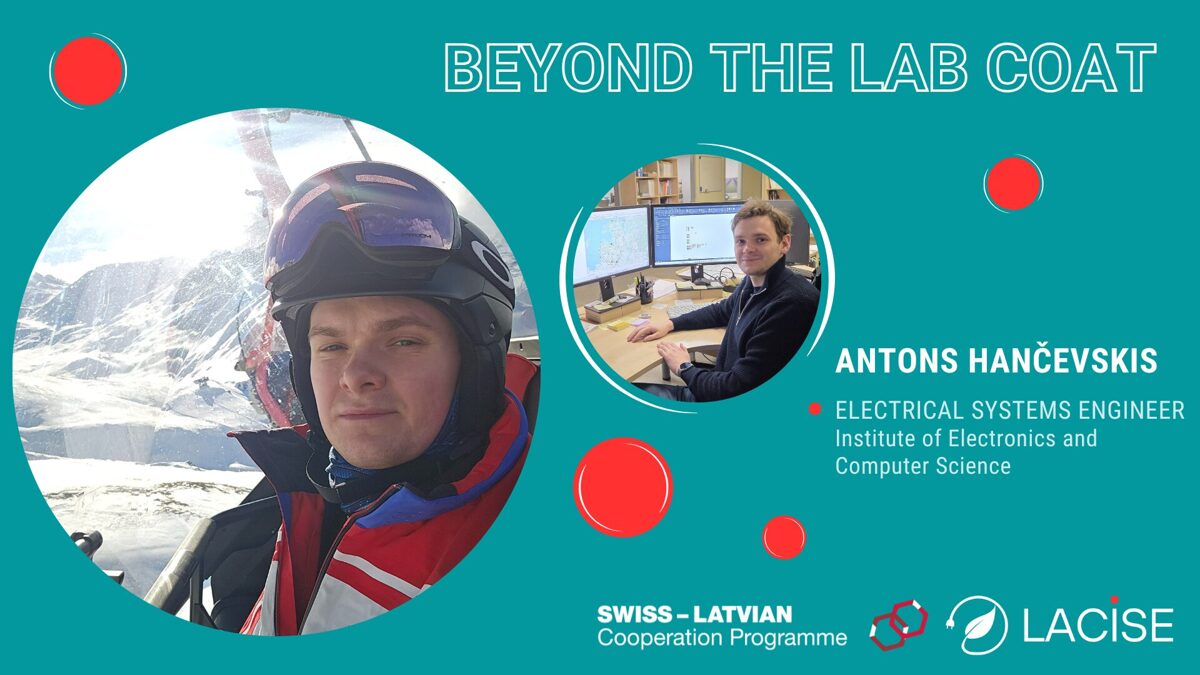
Beyond the Lab Coat - Antons Hančevskis (Institute of Electronics and Computer Science)
Did you dream of becoming a
scientist as a child? If not, what was your childhood dream job?
To be honest, I didn’t dream of
becoming a part of the scientific world; I was much more focused on something
in engineering or management. For a long time, I wasn’t even aware of the scale
of the scientific community in Latvia or how developed it actually is. However,
since joining the LACISE research team, I’ve been discovering this world and
diving deeper into it every day.
What inspired you to pursue
science?
My primary drive came from a
desire to delve deeper into Energy Systems and science itself. The turning
point was when Anna Mutule, my professor at Riga Technical University (and
supervisor for both my Bachelor’s and Master’s theses and upcoming PhD thesis),
offered me a fantastic opportunity to join the LACISE project alongside a team
of scientists from FEI (Institute of Physical Energetics) and EDI (Institute of Electronics and Computer Science). It was an opportunity I couldn't refuse.
What do you love most about
being a scientist today?
As a relative newcomer to
science, what I value most is the community. I love meeting people who have
been in research for a long time, learning from them, and listening to stories
about the various projects they’ve worked on. It is incredibly inspiring and
constantly gives me new ideas about what I could be a part of in the future.
What’s one myth about
scientists you’d love to bust?
I haven’t collected enough myths
to bust just yet! But I’m keeping my ears open and hope to identify a few good
ones in the near future.
What’s the weirdest or most
unexpected thing you’ve learned in your field?
I was surprised by the paradox of
collaboration. I’ve learned how difficult it can be to gather information and
initiate cooperation with stakeholders in the field—even when they are
interested and would clearly benefit from it. Convincing people to take that
first step and actually start working together is often harder than the
technical work itself.
What’s your favourite
non-science hobby?
I really enjoy skiing. Every
year, I try to travel to the Alps with my family. For me, that is the ultimate
holiday—it’s the one place and activity where my body and soul can recharge to
the maximum.
If science were a movie genre,
what would it be?
Science Fiction, without a doubt.
Most things we see in Sci-Fi films eventually come to life. And if they haven't
yet, it probably just means it’s too early, and we need to wait a bit longer
for the technology to catch up.
What’s your favourite movie?
The Devil Wears Prada. It’s a
nice, light movie with a good storyline and brilliant acting. Also, the music
there is great.
What’s your favourite book?
I wouldn’t say I have a single
favourite book, but I thoroughly enjoyed Theodore Dreiser's novel The Financier.
It tells the story of a financial genius and captures the intense atmosphere of
the business world, ambition, and the complex psychology behind success and
power.
What music or song always
inspires you?
I really enjoy Ozzy Osbourne. His
music holds a massive amount of energy that always gets me going.
If you weren’t a scientist,
what would you be doing today?
That is an easy one to answer
because I am doing it alongside research. Outside of science, I work as an
Electrical Engineer and the Head of the Technical Department at a firm. We
manufacture low-voltage power distribution and automation panels, and design
and assemble busbar systems for data centres and industrial buildings.
If you could invite any
scientist—past or present—to dinner, who would it be?
I would be very happy to have
dinner with Ferdinand Porsche. While he might not be strictly labeled a
"scientist" in the academic sense, he was a genius engineer and a
true pioneer in the automotive industry.